
Monitoring Desk
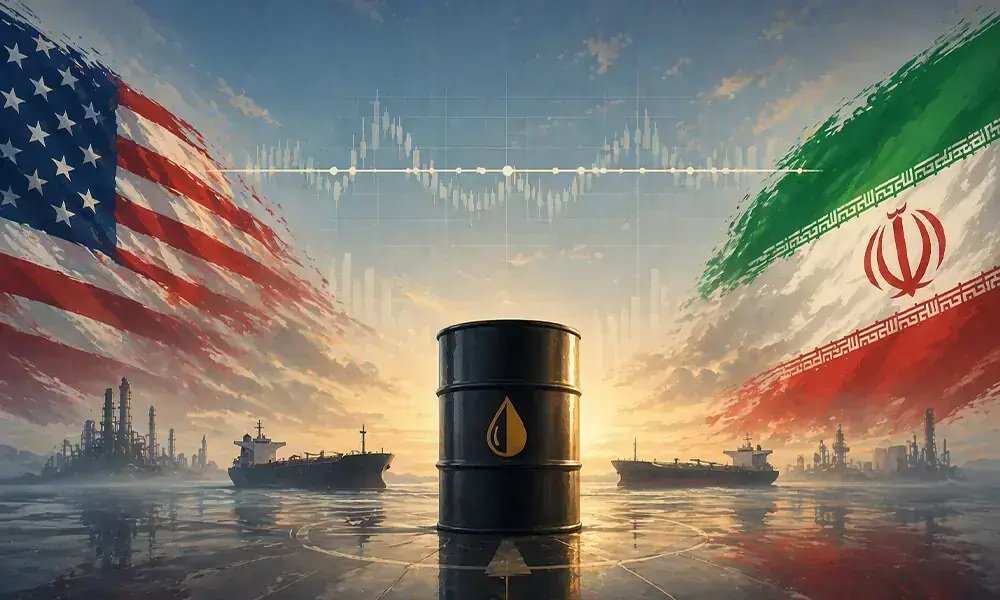
Oil prices rose more than 2% on Monday after US forces struck Iran’s Larak Island in the Strait of Hormuz, prompting retaliation from Tehran and raising fresh concerns over the reopening of the critical oil shipping route.
Brent crude futures climbed $2.21, or 2.51%, to $90.31 a barrel by 0436 GMT, while US West Texas Intermediate (WTI) crude gained $1.83, or 2.19%, to $85.23 a barrel.
The latest price surge came after US forces struck two launchers on Iran’s Larak Island in the Strait of Hormuz on Sunday. The strikes were the first known American attacks on Iran since late July and came as the conflict entered its sixth month.
Iran subsequently attacked two US air bases in Jordan, Iranian media reported on Monday, citing Iran’s Revolutionary Guards.
The renewed military escalation has added to uncertainty surrounding the Strait of Hormuz, a crucial route for global energy supplies through which around one-fifth of the world’s oil flowed before the war began at the end of February.
Negotiations aimed at ending the conflict remain at an impasse, while mediators are working to reopen the Strait of Hormuz. The latest military developments, however, have raised fresh concerns over how quickly normal shipping through the strategic waterway can resume.
Visible commodity vessel traffic through the strait fell to only five vessels a day over the weekend, according to shipping data, highlighting growing caution among shipping companies amid the risk of further attacks.
The United Kingdom Maritime Trade Operations also reported on Sunday that a tanker was struck by a projectile while sailing inbound through the Strait of Hormuz on Saturday.
The disruption to shipping is adding another layer of risk to already volatile global oil markets. Any prolonged restrictions on tanker movements through the strait could tighten oil supplies available to international markets and place further upward pressure on crude prices.
DBS Head of Energy Research Suvro Sarkar said the market was seeing greater chances of a contained confrontation rather than a sustained escalation, but repeated flare-ups continued to affect expectations over when the Strait of Hormuz could reopen.
He said expectations for a return to US-Iran negotiations by the end of the third quarter were becoming less likely and projected that oil prices could remain in the $85-$95 per barrel range unless greater clarity emerges over the situation in the strait.
The latest developments came despite Brent and WTI remaining on course for small monthly declines in August. Both benchmarks fell more than 4% last week, marking their first weekly decline in three weeks.
US President Donald Trump also said on Sunday that oil from a recently reached deal with Venezuela would be used to replenish the US Strategic Petroleum Reserve, which has fallen close to its lowest level in 44 years.
Trump had earlier said in a social media post that Iran’s energy hub of Kharg Island was being “blown to smithereens”. However, there was no evidence that the island was under attack, while the post, accompanied by an AI-generated clip, provided no further details.
Meanwhile, US Treasury Secretary Scott Bessent told Reuters that the United States was likely to impose new secondary sanctions on Iran on a weekly basis, adding another potential source of pressure on Iran’s oil trade.
The combination of military escalation, uncertainty over the Strait of Hormuz, declining tanker traffic and potential additional sanctions has kept the outlook for global oil markets highly sensitive to developments in the region.
For oil-importing countries, any sustained rise in international crude prices could translate into higher import costs and increased pressure on domestic fuel prices, particularly if the disruption to energy shipments persists.