
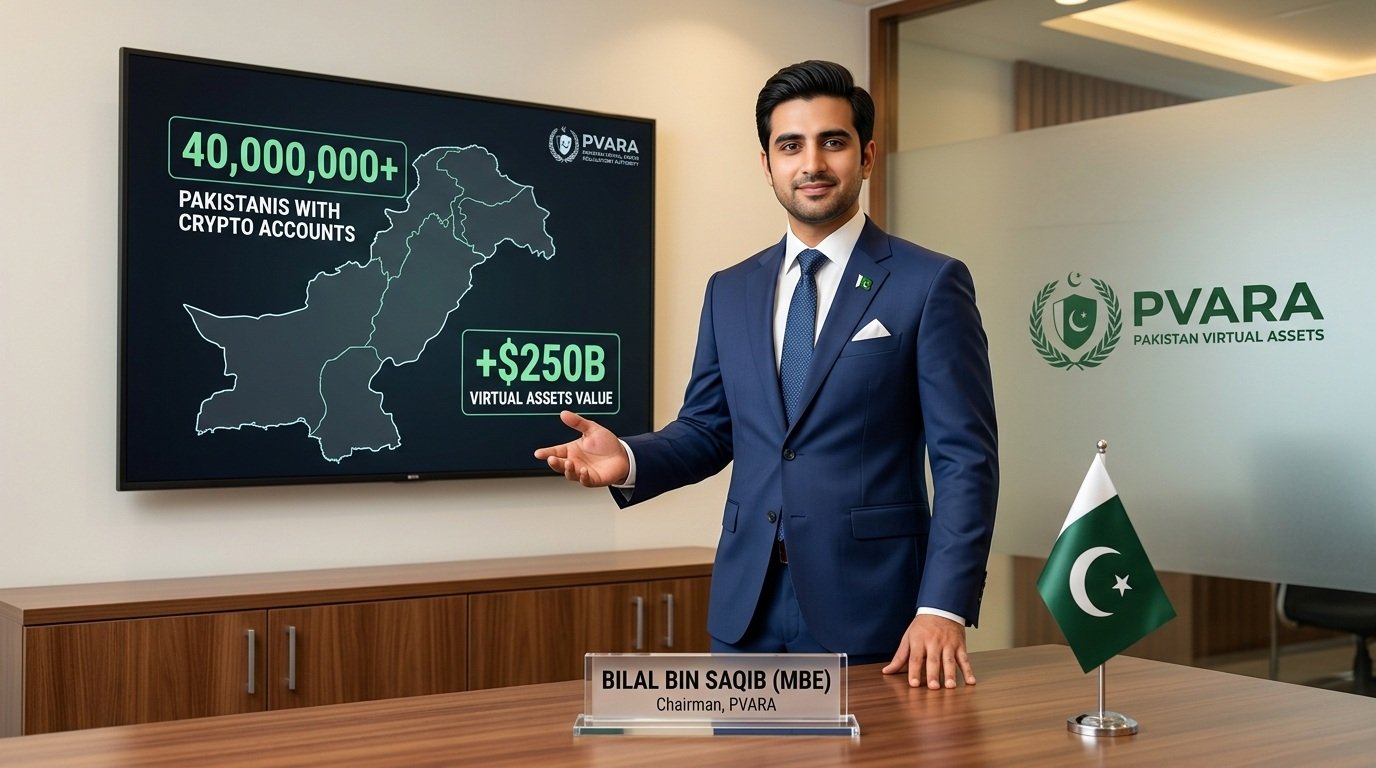
ISLAMABAD:Pakistan’s virtual assets regulator has revealed that around 40 million Pakistanis hold cryptocurrency accounts, while claiming the country has emerged as the world’s third-largest crypto market, with virtual assets worth around $250 billion in the country.
Chairman of the Pakistan Virtual Asset Regulatory Authority (PVARA) Bilal Bin Saqib made the disclosures while briefing the Senate Standing Committee on Cabinet Secretariat, saying the rapid adoption of the technology by young Pakistanis made regulation necessary rather than imposing restrictions on digital assets.
Bilal said the global market for virtual assets was already expanding rapidly, with countries including the UAE and Thailand actively developing regulatory frameworks for the sector.
He said young people wanted greater economic independence and had embraced cryptocurrency and other virtual assets, making Pakistan one of the major markets for the technology.
According to Bilal, Pakistan has become the third-largest crypto market, with approximately 40 million Pakistanis holding crypto accounts.
He said the State Bank of Pakistan had kept digital assets under restrictions for around eight years, arguing that banning technology effectively freezes a country while the rest of the world moves forward.
The PVARA chairman said Pakistan had already issued no-objection certificates to two international virtual asset companies as part of its effort to establish a regulated digital asset ecosystem.
He said virtual asset businesses had been given until September 5 to register with the authority, after which restrictions would begin against unregistered operators.
Bilal claimed Pakistan had established its virtual asset regulatory regime within five months, describing it as one of the fastest regulatory frameworks of its kind in the world.
He further claimed that Pakistan was ahead of India in virtual asset regulation, while noting that India had imposed a 30 percent tax on virtual assets.
“We do not want to do that in Pakistan,” Bilal said, explaining that the government was still considering an appropriate tax regime for virtual assets.
He warned that imposing excessive taxation could push crypto investors and businesses offshore, undermining the country’s efforts to bring the sector into the formal economy.
Bilal said the authorities were focusing on regulating people who had already invested in virtual assets rather than driving them away from the formal financial system.
The chairman said Pakistan’s virtual asset market had a reported volume of around $250 billion, while the amount of money held in virtual assets in Pakistan was estimated at between $10 billion and $20 billion.
He said the sector was predominantly being used by people under the age of 40, highlighting the strong participation of younger Pakistanis in the digital asset economy.
During the committee meeting, the Cabinet Secretary said cryptocurrency-related activities would not be allowed without a licence, arguing that licensing and regulation would help eliminate fraud from the sector.
Bilal said PVARA was now recruiting permanent staff to strengthen its regulatory capacity and had so far utilised only around 8 percent of the government budget allocated to it.
He also highlighted the potential of virtual assets and digital transactions to improve foreign exchange inflows into Pakistan.
According to Bilal, Pakistan receives around $41 billion in foreign exchange, and reducing transaction costs could potentially bring an additional $2 billion into the country.
He said the authority was examining ways to bring foreign exchange into Pakistan through cheaper channels in cooperation with the State Bank.
Bilal said the State Bank was represented on PVARA’s board and that both institutions were working together to determine more cost-effective mechanisms for bringing funds into the country.
He said the authority also wanted to capture transactions currently taking place through the grey market and bring them into a regulated framework.
Bilal further said Pakistan aimed to become a global leader in the use of virtual assets for Islamic finance, indicating that the regulator was exploring opportunities to combine digital assets with the country’s Islamic finance sector.
The regulator’s briefing comes as Pakistan moves towards formalising a sector that has already attracted millions of users despite years of regulatory uncertainty.
The scale of the user base and the billions of dollars reportedly held or transacted through virtual assets underscore the challenge facing policymakers: regulating the rapidly expanding sector while avoiding excessive taxation or restrictions that could push users and businesses offshore.