
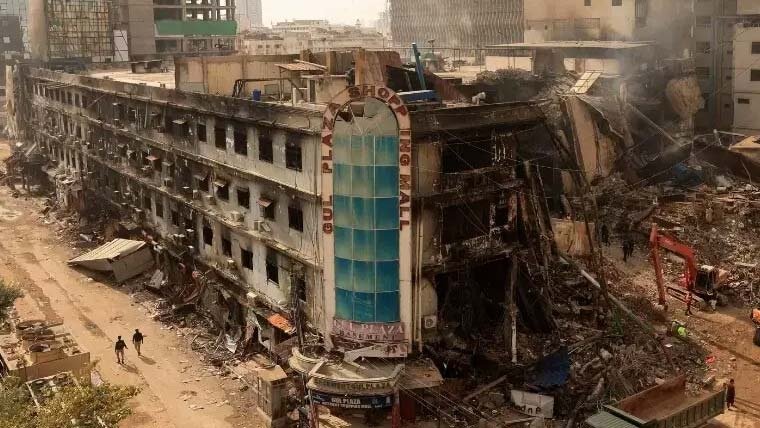
The judicial commission probing the Gul Plaza fire has fixed responsibility on multiple institutions and stakeholders, finding that the deadly tragedy resulted not from the fire alone but from prolonged safety violations, delayed response, poor enforcement and missed rescue opportunities.
The judicial commission’s report found that Gul Plaza remained in commercial use despite being classified as a dangerous building and being in violation of fire safety laws, while its management failed to rectify known deficiencies.
In its preface, Justice Agha Faisal quoted Mustafa Zaidi’s verse, “Main kis ke haath pe apna lahu talash karun, tamam shehar ne pehne hue hain dastane,” underscoring the report’s finding that responsibility for the tragedy extended across multiple institutions and stakeholders.
According to the report, Civil Defence inspections conducted in 2024 and 2025 had already identified the absence of fire safety equipment, the presence of inflammable material and deficiencies in emergency exits.
Despite these findings, no effective legal action was taken to address the identified violations. The report said even after courts became active in 2025, the legal process was not pursued to its conclusion.
The commission observed that the failure of Civil Defence was not due to a lack of knowledge about the danger, but rather a failure to enforce corrective measures despite the known risk.
The report also held the Gul Plaza administration responsible for failing to remove known defects and noted serious discrepancies in the building’s commercial structure. While the regularised plan provided for 1,102 shops, the building actually contained 1,153 shops.
Large quantities of inflammable commercial material were also present inside the shops, increasing the severity of the fire and the risks faced by those trapped inside.
The commission found that there was an extremely unwise delay in informing the fire brigade about the fire. It also noted that the disconnection of electricity plunged the building into darkness, further reducing the chances of people on upper floors escaping.
Despite the presence of a speaker system in the building, it was not used during the emergency.
The report also questioned the response of the fire brigade, observing that its arrival was delayed contrary to its own response standards. Effective firefighting began approximately 35 to 40 minutes after the incident.
A shortage of water and the need for refilling affected both firefighting and rescue operations. The commission noted that the failure to deploy essential equipment in a timely manner reduced the chances of rescuing people who remained trapped but were potentially accessible.
The report also raised serious administrative questions over claims that water reserves were available at fire stations, while effective water supply was not ensured during the initial phase of the operation.
The commission found that the District Administration was institutionally responsible for failing to conduct a joint audit of Gul Plaza despite a three-tier fire audit system established on the direction of the High Court.
The Deputy Commissioner South’s office was held institutionally responsible for failing to activate the available system of audit and monitoring.
The report further stated that the Sindh Building Control Authority could not escape responsibility by arguing that inspections were conducted only on the basis of complaints. It noted that the Sindh Building Control Ordinance provided powers to initiate corrective action against dangerous buildings.
The SBCA was held responsible for incomplete records relating to Gul Plaza and ineffective oversight of fire safety requirements.
The commission also examined the role of Rescue 1122 and found that rescuers arrived after the fire broke out but an effective opportunity for a major rescue operation still remained.
According to the report, rescue remained possible between approximately 11:15pm and 11:20pm, when some victims could still be seen. Access through the ramp also remained possible until around 11:30pm.
The commission found that Rescue 1122 failed to convert this available window into a large-scale rescue operation.
The report also identified failures concerning electrical safety. Under the law, electrical installations and equipment were required to undergo regular inspections, but the Electrical Inspector stated that no regular electrical inspection of Gul Plaza had been conducted.
The judicial commission concluded that responsibility for the tragedy could not be confined to a single institution or a single government.
It noted that across different periods, legal powers, audit mechanisms, building control arrangements, firefighting services and emergency response institutions were all in place, but the overall system failed to function effectively.
The commission concluded that people at Gul Plaza died not only because of the fire, but also because of delays, darkness, blocked exits and windows that became obstacles to escape.
It attributed the loss of life to an inactive safety system, ineffective audits, fragmented institutional responsibilities and rescue opportunities that were not utilised in time.