
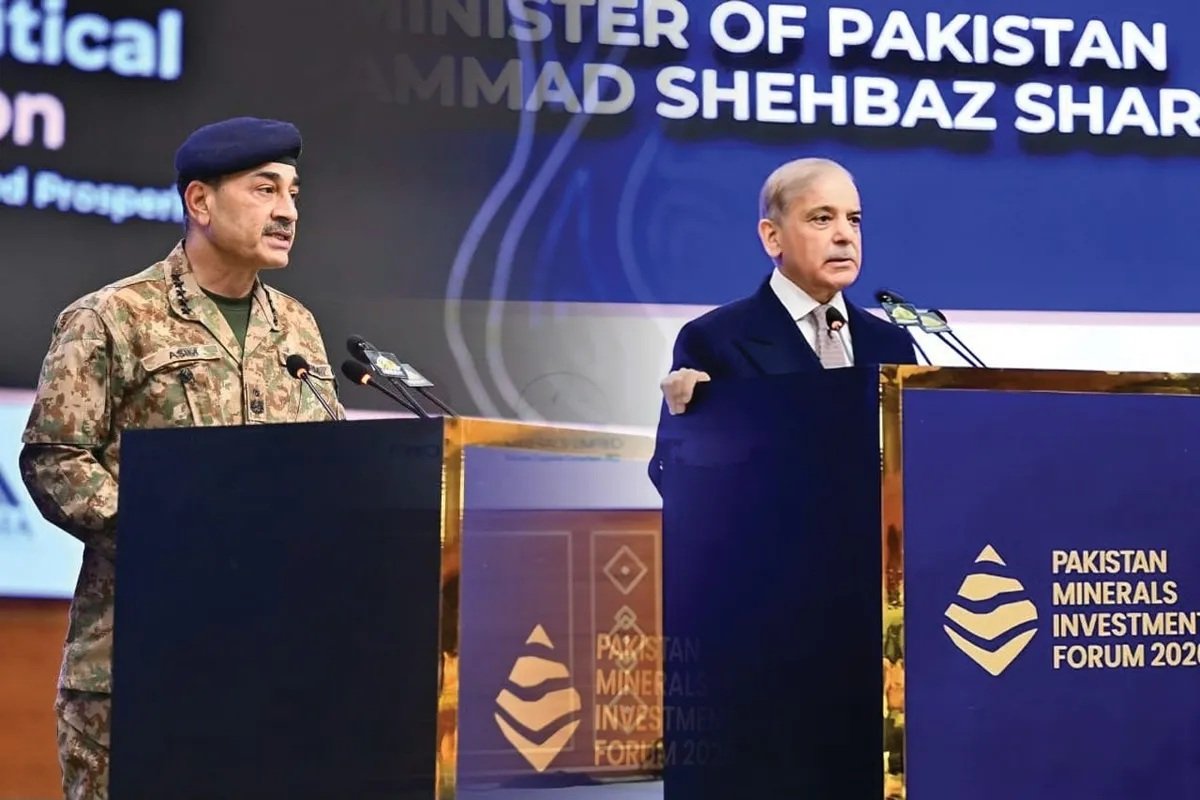
ISLAMABAD: Prime Minister Shehbaz Sharif and Chief of Defence Forces Field Marshal Asim Munir on Friday assured foreign mining investors of maximum security and urged them to establish processing and manufacturing facilities in Pakistan instead of exporting minerals in raw form.
Addressing the Pakistan Minerals Investment Forum 2026 in Islamabad, the prime minister called for a shift towards local processing, refining and manufacturing to transform the country’s mineral wealth into industrial growth, employment opportunities and economic prosperity.
“Mine in Pakistan, process in Pakistan, manufacture in Pakistan and then export to the rest of the world,” Shehbaz told international investors and mining executives.
He said Pakistan wanted major mining ventures, particularly the Reko Diq project and other projects in the mineral-rich southwestern region, to establish refineries, smelters and manufacturing facilities for products such as cables and conductors.
The prime minister said exporting raw minerals without adding value would not enable Pakistan to fully benefit from its natural resources, stressing that mineral development must create local employment, promote businesses and strengthen the country’s industrial base.
He recalled his commitment at last year’s forum to ending the export of unprocessed minerals, expressing confidence that Pakistan would gradually move towards domestic processing and value addition.
Shehbaz said the country’s mineral wealth must benefit local communities through employment, business opportunities, schools, healthcare facilities and access to clean drinking water.
He stressed that the federal and provincial governments would work together with investors to ensure that communities living near mining sites became the main beneficiaries of economic activities, while development and environmental protection went hand in hand.
The prime minister also acknowledged investors’ security concerns, saying the protection of their personnel, assets and supply routes was a fundamental responsibility of the government.
“Your safety is our safety, and your protection is our protection,” he told participants.
Chief of Defence Forces and Army Chief Field Marshal Asim Munir also assured investors that all possible measures were being taken to protect mines, miners, investments, industries, projects and people associated with the mining sector.
According to a statement issued by the military’s media wing, he said Pakistan aimed to become a competitive destination for long-term mineral investment and stressed that harnessing the country’s mineral wealth was a collective national objective.
Field Marshal Munir emphasised that Pakistan’s objective was not merely to export raw materials but to develop the entire mineral value chain, including extraction, refining and manufacturing, to generate sustainable economic benefits.
He also stressed that mineral development must translate into tangible improvements in the lives of people living in resource-rich areas, adding that Pakistan needed to move from resource potential to productivity and from raw exports to value-added growth.
The security assurances come amid persistent militant attacks in Balochistan, where security concerns have emerged as a major challenge for mining companies and foreign investors.
Canada-based Barrick Mining Corporation announced in April that it would slow development of the Reko Diq copper-gold project in Balochistan, highlighting the challenges facing large-scale mining investments in the province.
Pakistan has also been considering additional security arrangements, including a dedicated paramilitary force to protect mineral-rich areas and secure the province’s borders with Iran and Afghanistan.
The prime minister also pledged to simplify investment procedures, remove bureaucratic hurdles and ensure transparency in the award of mining licences and contracts.
He said the federal and provincial governments would coordinate to facilitate investors, while digitisation of geological records would help companies assess mineral deposits before committing investment.
Shehbaz directed investors to bring any files delayed by bureaucratic procedures directly to him, promising to ensure their speedy processing.
He further said commercial production at the Reko Diq project was expected to begin in 2028.
The project, being developed by Barrick in Balochistan, is considered central to Pakistan’s efforts to attract foreign investment, develop its copper and gold reserves and expand mineral exports.
The prime minister also urged mining companies to establish vocational training centres, transfer technology and develop local suppliers so that domestic businesses and workers could benefit from mining investments.
The two-day Pakistan Minerals Investment Forum 2026, which began on Thursday, has brought together government officials, international investors and mining executives to explore investment opportunities in Pakistan’s mineral sector.
Meanwhile, Ivanhoe Atlantic Chairman Robert Friedland announced on Thursday that the Canada-based company had signed a memorandum of understanding with Pakistan’s Mari Energies and was preparing to establish a local office in the country.